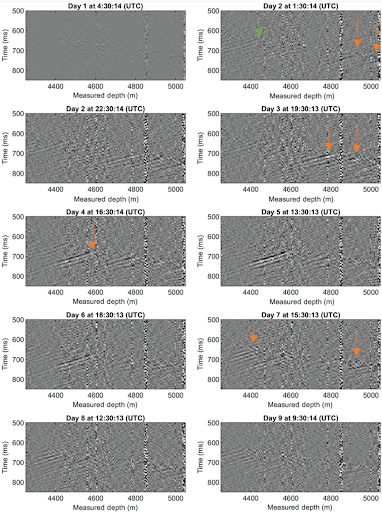
Published: March 17, 2026
Summary: Software automates continuous seismic data processing from fiber-optic sensors and permanent seismic sources. It enables highly temporal sampling of time-lapse monitoring for long-term subsurface surveillance in geological applications.
Applications:
- Geothermal reservoir surveillance
- Oil and gas field monitoring
- Subsurface resource management
- Hydraulic fracturing monitoring
- Carbon storage site monitoring
Advantages/Benefits:
- Automated seismic data processing
- Enables continuous, long-term subsurface monitoring (4D seismic)
- Supports diverse energy and environmental applications
- Provides quality-controlled, interpretable seismic outputs
- Provides high temporal sampling for time-lapse seismic
Background: Subsurface monitoring for resource management and environmental safety demands continuous, high-resolution seismic data. Current methods struggle with the immense volume and complexity of continuous seismic data from advanced sensing systems. Manual or conventional processing is inefficient, hindering timely and consistent time-lapse analysis.
Technology Overview: Scientists at Berkeley Lab have developed Permanent Source – Distributed Acoustic Sensing (PESO-DAS), a software platform that automates the processing of continuous seismic data acquired from Distributed Acoustic Sensing (DAS) fiber-optic systems and permanent seismic sources, such as the Surface Orbital Vibrators (SOVs). This tool generates processed shot gathers and quality control plots, enabling real-time time-lapse (4D) seismic monitoring. It supports long-term subsurface surveillance for applications like geological carbon storage, geothermal reservoirs, and oil and gas fields. Its use can allow, for example, daily snapshots of CO2 plume evolution during carbon storage or hourly snapshot of fracture growth during hydraulic fracturing.
This technology is differentiated by streamlining the complex workflow of continuous seismic monitoring, specifically integrating DAS and SOVs for advanced subsurface imaging. Its automation capabilities provide a robust solution for long-term, high-resolution surveillance, crucial for dynamic environments. The software’s specialized design for this combined sensing approach offers a unique advantage in managing and interpreting fiber-optics datasets for critical resource management. Developed in Matlab for Windows, it uses proprietary code. Deliverable as an executable file.
Researcher:
Opportunities: Available for licensing and / or collaborative research
For More Information: