
April 3, 2026
Summary: This electrochemical reactor design accurately measures individual electrode potentials and efficiently performs multi-step chemical conversions by precisely controlling intermediate product flow within a single device.
Applications:
- CO2 to ethylene production
- Fuel cell performance monitoring, diagnostics, and analysis
- Electrolyzer efficiency optimization
- Multi-step chemical synthesis
Advantages/Benefits:
- Accurate electrode potential measurement
- Enhanced selectivity for multi-step reactions
- Minimal operational disruption
- Versatile dual functionality (characterization & reaction)
Background:
Current electrochemical cells often limit performance analysis by providing only full cell voltage measurements. Integrating reference electrodes typically disrupts operation, while multi-step reactions suffer from poor intermediate control and reduced selectivity. There is a growing need for advanced devices that enable precise characterization and efficient multi-step reactions to optimize performance and create valuable products.
Technology Overview:
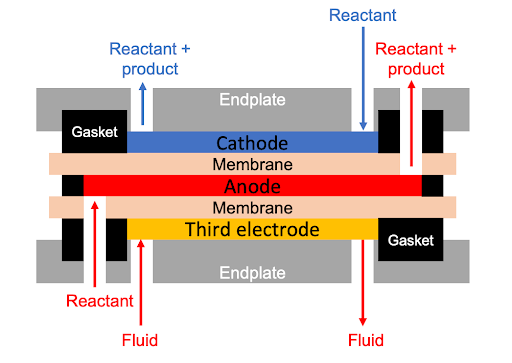
Scientists at Berkeley Lab have developed a Membrane 3-Electrode Assembly (MEA) device that functions as either a tandem electrochemical reactor or an MEA with an integrated reference electrode. As a tandem reactor, it uses two cathodes around a central anode for sequential conversion of reactants to intermediate and final products with controlled flow. As an MEA-type electrochemical device (fuel cell or electrolyzer), a second membrane separates the reference electrode from the anode, enabling precise measurement of individual electrode potentials.
This technology is differentiated by its ability to enhance selectivity for multi-step reactions like CO2 reduction to ethylene through controlled intermediate transport, overcoming limitations of free diffusion. The integrated, membrane-separated reference electrode provides accurate potential data without disrupting normal device operation, addressing issues with traditional two-electrode MEAs and external reference electrodes. The tandem reactor configuration has demonstrated advantages in selectivity and efficiency for CO2 reduction to ethylene. The technology is useful for monitoring fuel cell performance and identifying when maintenance or repair is required.
Development Stage: TRL 4; Component and/or system validation in laboratory environment
Inventors:
Status: Patent pending
Opportunities: Available for licensing and / or collaborative research
