
Date published: March 9, 2023
Summary: An approach to improve biomass deconstruction efficacy utilizing lignin-derived Schiff-base ionic liquids (SBILs)
Applications:
- Conversion of waste biomass into biofuels and/or bioproducts
Advantages/Benefits:
- Provides an approach to employ under-utilized lignin fractions
- Cost-effective production of fermentable sugars and lignin fractionation (a major hurdle for producing commercially viable bioenergy from waste biomass)
- Efficient processing of a wide range of biomass types (e.g., softwood, hardwoods, grasses, agricultural residues)
- Easy synthesis of lignin-derived ionic liquids (ILs)
Background:
- Lignocellulosic biomass is a renewable feedstock that can be used to produce fuels and value-added chemicals. The conversion of lignocellulosic biomass is demanding and requires a suitable pretreatment solvent for delignification. Although ionic liquids (ILs) have mitigated issues involved in the processing of biomass, there is a need for an IL which can more efficiently remove the lignin and enhance the fermentable sugars.
- Organic salts with iminium ions are suitable Schiff-base ionic liquids (SBILs) for this invention. Depending on the specific acid or base being utilized for making SBILs, certain physio-chemical properties (e.g., low melting point, low viscosity, high thermal stability) can be achieved. These are desired features in an IL for efficient biomass pretreatment. SBILs have not previously been employed for biomass pretreatment and processing.
Technology Overview:
Researchers at Berkeley Lab’s Joint BioEnergy Institute have developed a unique approach to improve biomass deconstruction efficacy utilizing lignin-derived Schiff-base ionic liquids (SBILs).
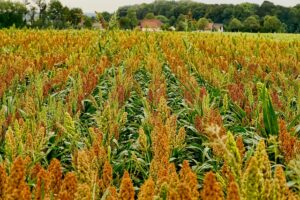
Biomass (sorghum) pretreatment experiments were conducted to study the efficacy of prepared SBILs as a function of sugar yields. The saccharification of SBIL-pretreated biomass (20wt% biomass and 80wt% IL loadings) released up to 88% glucose and 76% xylose. The novel invention leverages several key properties related to performance as effective pretreatment solvents.
The process will help in achieving a high concentration of fermentable sugars while leaving the residual lignin for valuable chemicals. Additional work will be carried out to optimize the pretreatment process in terms of screening of SBILs, reaction conditions, lignin removal, sugar yields, and possible recycling.
Development Stage: Proof of concept, etc.
Inventors:
- Mood Mohan
- Hemant Choudhary
- Venkataramana Pidatala
- Blake Simmons
- Seema Singh
- John Gladden
Status: Patent pending
Opportunities: Available for licensing and collaborative research
