
Date published: June 17, 2026
Summary:
This technology uses machine learning models to simulate virtual strains of organisms and identify potential biological modifications.
Applications
- Synthetic biology strain design
- Microbial metabolic engineering
- Pharmaceutical drug production optimization
Advantages/Benefits
- Virtual organism simulation
- Optimized biological modifications
- AI-driven predictive modeling
- Accelerated strain development
Background
Synthetic biology modifies organisms to produce valuable compounds. Current approaches heavily depend on manual trial-and-error and traditional in vivo testing. These methods are notoriously slow, resource-intensive, and struggle to account for the complex kinetic dynamics inherent in biological systems, causing inefficient strain development. There is a critical need for advanced computational tools to accurately simulate virtual strains and predict effective genetic modifications before conducting costly physical experiments.
Technology Overview
Kinetic Learning software (2018-038): Scientists at Berkeley Lab have developed a kinetic learning system that utilizes advanced machine learning models to simulate virtual strains of organisms. This technology provides comprehensive methods for training algorithms to accurately model biological behaviors. By leveraging these predictive capabilities, researchers can efficiently determine and evaluate possible modifications to an organism before conducting physical experiments.
This technology shifts biological engineering from traditional, resource-intensive trial-and-error methods to precise virtual simulations. Unlike standard static modeling, this kinetic learning approach dynamically predicts how specific modifications will impact an organism’s complex pathways. By enabling the rapid virtual testing of microbial strains, it drastically accelerates the development pipeline for synthetic biology applications.
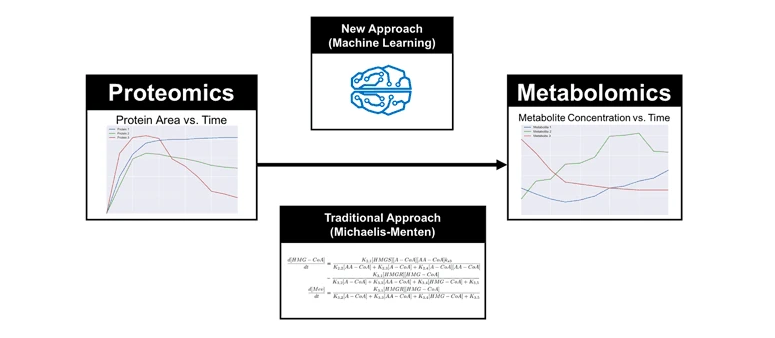
Kinetic Deep Learning software (2025-084): Built on a new code base, Kinetic Deep Learning employs deep learning to use protein levels to predict times series of metabolite concentrations. Understanding this type of pathway dynamics is important in order to predict the behavior of the pathway and to reliably design biological systems (such as strains bioengineered to produce chemical products).
Past kinetic models have consisted of differential equations based on the Michaelis-Menten dynamics. However, these methods rarely produce good quantitative fits to measured data time series. This model substitutes the Michaelis-Menten description of pathway dynamics with algorithms that automatically learn these dynamics from previously obtained metabolomics and proteomics data using machine learning approaches. The software uses deep learning to map proteomics time series to metabolite concentration time series, instead of learning and then integrating the first metabolite derivative (as with Kinetic Learning software)
The researchers collected one of the largest public multiomics synthetic biology datasets generated to date, and used it to train the deep learning model with 90-99% accuracy for production time series and 96% accuracy for final production. The model successfully predicted outputs for a range of extracellular and intracellular metabolites in a non-model yeast (Pichia kudriavzevii) engineered to produce malonic acid. Because the approach derives all necessary knowledge from experimental data, it is broadly applicable across different hosts, pathways, and products.
Development Stage: Version 1
Inventors/Developers:
Tijana Radivojevic
Jose Manuel Marti
Zachary Costello
Status: Kinetic Learning and Kinetic Deep Learning are copyrighted. Kinetic Learning is patent pending.
Opportunities: Available for licensing and / or collaborative research
For More Information:
Costello, Zak, and Hector Garcia Martin. “A machine learning approach to predict metabolic pathway dynamics from time-series multiomics data.” NPJ systems biology and applications 4.1 (2018): 1-14
Marti, J.M. (2025). Prediction of metabolic dynamics through deep learning and high-throughput multiomics data, bioRxiv, https://www.biorxiv.org/content/10.1101/2025.05.27.656438v1.abstract
